
What Is a Robot Marathon Really Testing?
A robot marathon is more than a speed race. It tests battery control, cooling, balance, sensors, and AI decision-making under real-world pressure.
Table of Contents
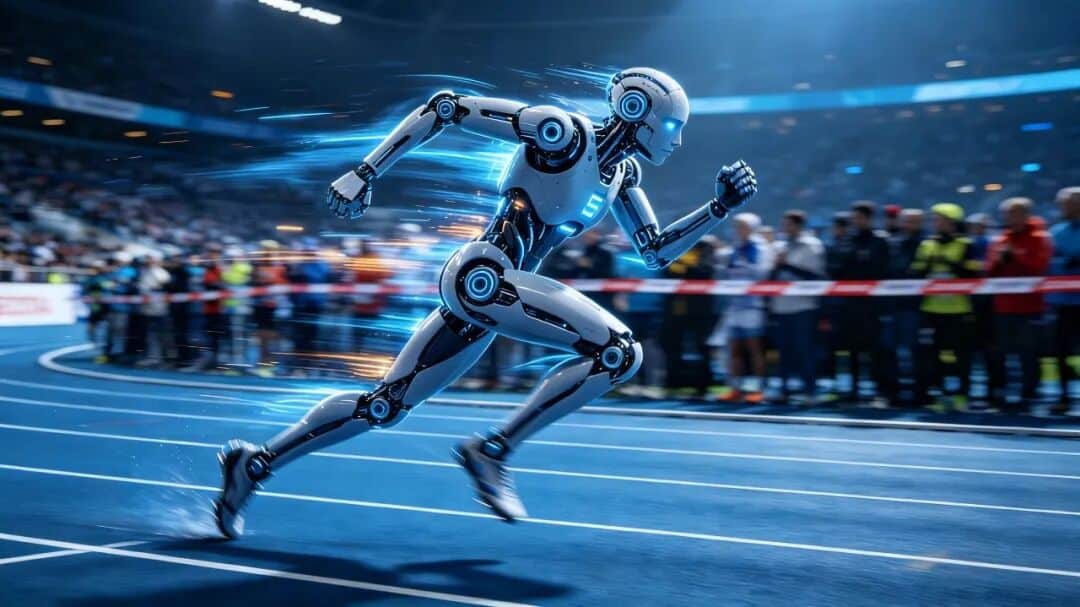
When I first saw the time, I almost read it twice.
50 minutes and 26 seconds.
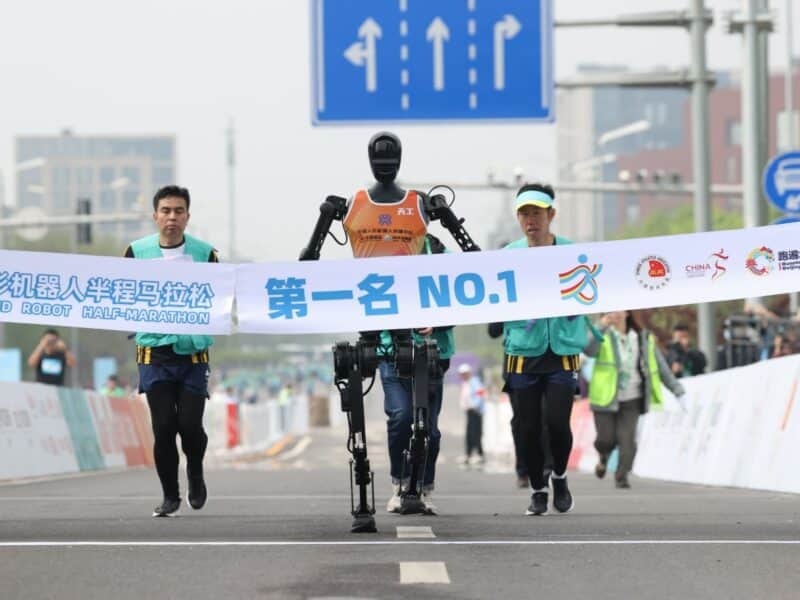
That was the winning time of Honor’s humanoid robot “Lightning” at the 2026 Beijing Humanoid Robot Half-Marathon. The race distance was 21.0975 kilometers, the same as a normal half marathon. Even stranger? That time was faster than the men’s human half-marathon world record of 57 minutes and 20 seconds.
At first, I wanted to ask a simple question:
Are robots now better runners than humans?
But after looking closer, I realized this race was not just about speed. It was more like a giant stress test on two legs.
That is why I think a robot marathon is so interesting. It turns a city road into a lab. It shows us what breaks, what overheats, what learns, and what still needs human help.
At AX Robots, I see this kind of race as a moving window into the future of humanoid robots.
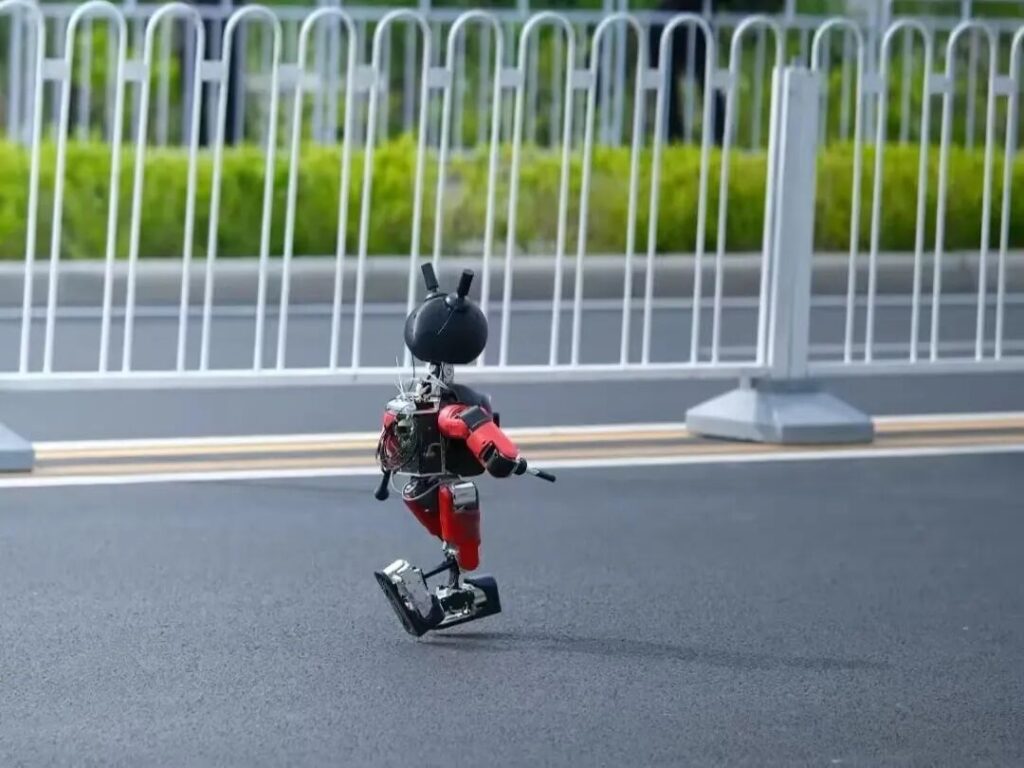
Three Hardware Tests Behind the Race
A robot cannot just “try harder” when it gets tired.
It has no lungs. No sweat. No sore muscles.
Instead, it has batteries, motors, cooling pipes, sensors, and control systems. If one part fails, the whole body may slow down or fall.
So what is a robot marathon really testing?
Three things stand out to me: power, cooling, and balance.
The “Fitness Coach”: Battery Management
When I run, I need to save energy.
If I sprint too early, I regret it later. My legs feel heavy. My breathing gets messy. I start bargaining with myself: “Just reach the next tree!”
A robot has a similar problem, but its “energy coach” is not a human brain. It is the Battery Management System, or BMS.
The BMS watches the robot’s battery in real time. It checks how much power is left. It helps decide how much energy should go to each motor.
This matters because a humanoid robot does not move like a toy car.
Its knees, ankles, hips, and arms all need power. When it climbs a slope, it may need a sudden burst. When it runs on flat road, it needs steady output. When it turns, it needs careful control.
The BMS must do all of this while keeping the battery safe.
If one battery cell charges too much or drains too far, the system can become risky. So the BMS also helps balance the cells, protect battery life, and keep power stable.
I like to think of it as a coach running beside the robot, whispering:
“Don’t waste power here.”
“Push harder now.”
“Save some energy for the hill.”
Without that coach, even a fast robot may not finish.
The Anti-Heatstroke System: Liquid Cooling
Here is a scene I can picture clearly.
The robot is running under the morning sky. Its feet hit the road again and again. Inside its legs, tiny motors are spinning at high speed. The outside looks smooth and calm.
But inside?
Heat is building fast.
Anyone who has run on a hot day knows how dangerous heat can feel. Your face burns. Your shirt sticks to your back. You slow down because your body is begging for relief.
Robots can “overheat” too.
Their motors, especially in the legs, work very hard during long-distance running. The knee and ankle motors carry the body’s weight and push it forward again and again. If those motors get too hot, performance drops. In serious cases, the robot may stop.
Last year, many robots mainly used air cooling, like small fans.
That helps, but only up to a point.
Honor’s “Lightning” used a more advanced liquid cooling system. This is more like how blood carries heat away in the human body. Cool liquid moves through thin paths near the hot parts and takes heat away faster.
That sounds simple, but it is hard to build.
A humanoid robot’s joints are small. There is not much room for pipes, pumps, motors, wires, and sensors. Every gram matters. Every space matters.
According to the race reports, Lightning used liquid cooling to support high motor speed and stable running. The result was clear: it did not just run fast for a few seconds. It kept moving for the whole course.
That is the difference between a sprint trick and real engineering.
The “Instinct” to Stay Balanced
Speed is exciting.
But balance is survival.
During the race, the course included flat roads, slopes, turns, speed bumps, and city road conditions. Some turns were sharp. Some parts forced robots to slow down, adjust, and choose a safe path.
Now imagine this scene.
A robot enters a turn. Its foot lands slightly wrong. Its body tilts. A small part on the foot becomes loose after a bump or light contact. For a second, the whole run could end.
A human runner might wave their arms, twist their ankle, and somehow recover.
A good robot must do something similar, but with sensors and code.
This is where dynamic balance control becomes important.
A humanoid robot can use force sensors in its feet to feel pressure from the ground. These sensors can detect changes very quickly. Is the road flat? Is the foot slipping? Is the robot leaning too far?
Then the control system changes motor force and body position.
It happens so fast that it almost feels like instinct.
The robot is not “thinking” in a slow way, like:
“Oh no, I am falling. What should I do?”
Instead, it reacts in tiny steps, many times per second.
This is like a runner’s muscle memory. After enough training, you do not plan every movement. Your body just adjusts.
Robots train too, but often in simulation. Engineers can create millions of virtual falls, bumps, and turns inside a computer. The robot learns better actions before it ever touches the real road.
That is why a marathon matters. A lab floor is polite. A city road is not.
Why Seeing Clearly Is Hard at High Speed
Running fast creates another problem: the robot must still “see.”
A robot may use cameras, LiDAR, and an IMU.
A camera helps it recognize lane lines, road edges, signs, and objects.
LiDAR sends out laser signals to measure distance and build a 3D view of the world.
An IMU measures movement, tilt, speed changes, and body direction.
Each sensor has a weakness.
A camera can blur when the robot moves fast. LiDAR can face noise from the environment. An IMU can drift over time, meaning small errors slowly grow bigger.
One tiny error may not matter.
But over 21 kilometers? That error can become a big problem.
So robots use sensor fusion. That means they combine different sensor data to get a clearer picture.
It is like walking in the dark with your eyes, ears, and feet working together. If one sense is unsure, another helps.
For a robot, this can mean the difference between following the route and drifting toward danger.
The Brain and the “Small Brain”
I like this way of thinking:
The robot has a big brain and a small brain.
The big brain makes larger decisions.
It asks questions like:
“Where is the route?”
“Should I slow down for the turn?”
“Is that object in the way?”
“How much battery do I have left?”
The small brain handles fast body control.
It adjusts foot placement. It changes motor force. It reacts to bumps, small stones, slopes, and sudden movement.
In a marathon, both must work together.
If the big brain is smart but the small brain is slow, the robot may know the right path but still fall.
If the small brain is quick but the big brain is weak, the robot may move well but choose a bad route.
That is why full autonomy is so hard.
In this year’s event, about 40% of the robots used autonomous navigation, while others still needed remote control or human help in certain moments.
That detail matters.
A remote-controlled robot can be impressive, but it is still leaning on human judgment. A fully autonomous robot must read the road, make decisions, and recover by itself.
That is a much harder test.
Three Types of Robot Runners
After watching this race, I would divide the robots into three simple groups.
| Type | How it runs | What it shows |
|---|---|---|
| Remote-controlled | A human gives commands | Good hardware, but less independence |
| Semi-autonomous | Robot runs alone in easy parts, human helps in hard parts | A practical middle step |
| Fully autonomous | Robot sees, decides, and moves by itself | The future direction |
Remote-controlled robots are like puppets with powerful legs.
Semi-autonomous robots are like student drivers. They can handle normal roads, but may need help in tricky places.
Fully autonomous robots are the most exciting. They are not just moving machines. They are decision-making machines.
And that is where humanoid robots start to feel truly different.
Why the Big Jump Matters
The progress from last year to this year is hard to ignore.
Reports say the 2025 winning robot took about 2 hours and 40 minutes. In 2026, Lightning finished in 50 minutes and 26 seconds. That is a huge leap in one year.
To me, this does not mean one single part suddenly became magical.
It means many systems improved together.
The motors became stronger.
The battery control became smarter.
The cooling became better.
The balance became faster.
The sensors became more useful.
The software became more confident.
That is what makes humanoid robotics so difficult.
You cannot win with only one good part.
A powerful motor is useless if it overheats.
A smart camera is useless if the legs cannot react.
A big battery is useless if the robot becomes too heavy.
Fast speed is useless if the robot falls at the first sharp turn.
A robot marathon punishes weak links.
That is why I see it as a full-body exam.
So, What Is the Race Really About?
The easy answer is speed.
But I do not think that is the real story.
The real race is about whether a robot can handle pressure in the real world.
Can it manage energy?
Can it stay cool?
Can it balance after a mistake?
Can it see the road clearly?
Can it decide without waiting for a human?
Can it keep moving when the environment is not perfect?
That is why this race feels bigger than sports.
One day, humanoid robots may work in warehouses, hospitals, factories, disaster zones, and homes. Those places will not be smooth lab spaces. They will have stairs, wet floors, tight corners, people walking around, and objects in strange places.
A marathon is not the final goal.
It is a loud, public test.
And honestly, it is a fun one.
When a robot named Lightning runs past the finish line faster than a human world record, it makes people cheer. But for me, the more exciting part is hidden inside the legs, battery pack, cooling system, sensors, and code.
That is where the real race is happening.
And that is the kind of race AX Robots will keep watching closely.
 2026 Smart Robotics Industry Report
 What Is the Meaning of Humanoid Robots Running a Marathon?
 What Is the Difference Between RV Reducers and Harmonic Reducers in Industrial Robots?
 Actuator Applications in Automation and Robotics: A Beginner’s Guide