
What Is the Meaning of Humanoid Robots Running a Marathon?
A robot half-marathon showed that humanoid robots still fall, fail, and learn. Their shaky steps reveal the real path from lab demos to useful machines.
Table of Contents
Robot Marathon Race
I did not expect a robot marathon to make me laugh first.
One robot fell almost right after the start. Another one lost its head, got help, and kept going. The only “beauty robot,” Huanhuan, stopped working soon after the race began. Even Unitree’s G1 had a fall.
It looked funny. Very funny.
But after I stopped laughing, I kept thinking: maybe this was exactly the point.
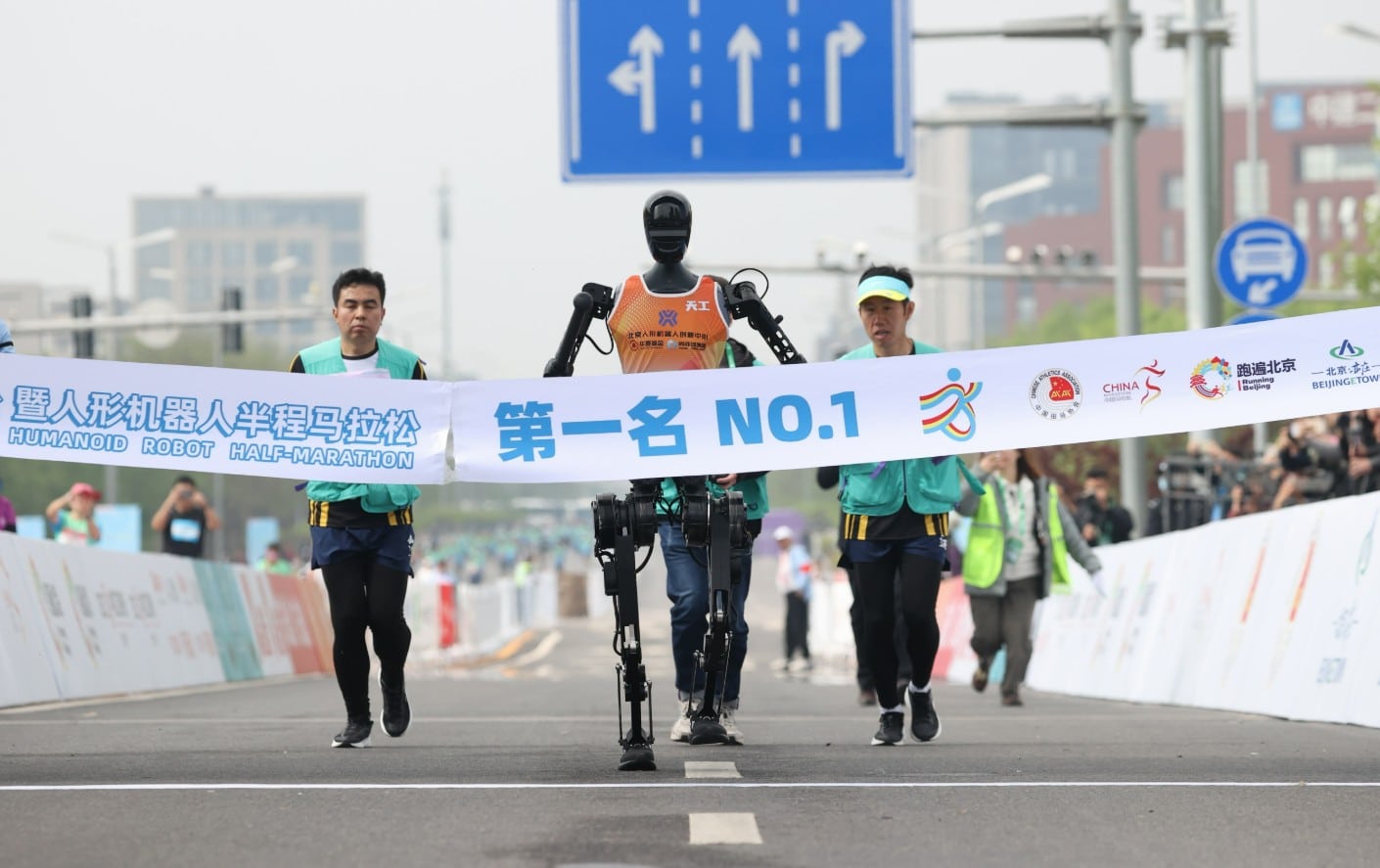
On April 19, 2025, Beijing Yizhuang held the world’s first humanoid robot half-marathon. The course was 21.0975 kilometers long, and about 20 robot teams joined the race. The winner, Tiangong Ultra, finished in 2 hours, 40 minutes, and 42 seconds.
Only a few robots reached the finish line. Reports said six finished the race, while many others fell, overheated, or needed help from engineers.
Still, I did not see failure.
I saw a robot taking small, shaky steps on a real road, with engineers running beside it, ready with tools and batteries. I saw sunlight on the track, people holding up phones, and a machine trying hard to keep its balance like a child learning to walk.
That image stayed with me.
At AX Robots, I often write about machines that look cool in videos. Smooth arms. Fast moves. Perfect lighting. But this race felt different. It was messy, loud, and real.
And real is where technology grows up.
Forcing the Industry to Move Faster
A lab is safe.
A real road is not.
In a lab, the floor is flat. The light is controlled. The robot knows what will happen next. On a marathon course, the ground changes. The robot must turn, climb, slow down, speed up, and manage its power.
That is a much harder test.
The Beijing Yizhuang course had slopes, left turns, right turns, and no easy “reset button.” If a robot slipped on a slope, everyone saw it. If its legs shook during a turn, everyone saw that too.
That may sound embarrassing.
But is it really?
I think it is useful.
A robot that falls in public gives engineers something more valuable than a polished demo: real data. How much power did it use on the hill? Why did the sensor judge the ground wrongly? Which joint became unstable after many kilometers?
These answers matter.
A humanoid robot that wants to work in a factory, a warehouse, a hospital, or even a home must handle the real world. It cannot only walk across a stage for three minutes.
Imagine this scene.
A robot is carrying a box in a warehouse. The floor has a small bump. A worker walks past. A cart turns the corner. The robot must notice, adjust, and keep moving.
That is not science fiction. That is the kind of future many companies are trying to build.
The marathon showed that current humanoid robots are still not fully ready. Their balance, battery life, heat control, and joint coordination still need work.
But I would rather see the problems now than hide them behind perfect videos.
The race was like an exam.
The track asked hard questions. The robots gave honest answers.
Staying With the “Marathon” Mindset
The most moving part of this race was not the fastest robot.
For me, it was the robots that kept trying.
One robot may take a few steps, shake, stop, and start again. Another may need a battery change. Another may fall, get lifted up, and continue with an awkward little run.
It is easy to laugh.
I laughed too.
Then I thought about the engineers behind them. They were probably tired, nervous, and maybe even a little embarrassed. But they kept working beside their robots, step by step.
That is what long-term technology looks like.
Humanoid robots are not like phones. You cannot improve them only by making the screen brighter or the chip faster. A humanoid robot has to deal with balance, weight, joints, power, sensors, software, heat, safety, and cost.
That takes time.
A lot of time.
Boston Dynamics’ Atlas became famous because it could jump and do parkour, but even a robot that amazing still faced the hard question of real-world use. Honda’s ASIMO was once a symbol of the future, yet it also showed how long and difficult the road can be.
So when I watched China’s humanoid robots fall and rise again, I did not see a joke.
I saw an early chapter.
History has many moments like this. Early electric lights were mocked. Early cars were laughed at by people who trusted horses more. Many great tools looked strange before they became normal.
Maybe humanoid robots are in that strange stage now.
They are not ready to run our homes. They are not ready to replace human workers in most places. They are still clumsy. They still need help.
But every fall teaches something.
Every broken part tells a story.
Every finish line, even a slow one, becomes a small map for the next try.
This is why the robot marathon matters.
It was not just a race about speed. It was a race about honesty. It showed the public what humanoid robots can do today, and what they still cannot do.
That honesty is healthy.
At AX Robots, I believe people should see both sides of robotics: the exciting side and the awkward side. The shining demo matters, but the fall on the track may matter even more.
Because the future is not built by machines that never fall.
It is built by teams that learn why they fell, fix the problem, and send the robot out again.
One day, maybe we will see humanoid robots walking calmly through city streets, helping in disaster zones, moving goods in warehouses, or supporting elderly people at home.
When that day comes, we may look back at this marathon and smile.
We may remember the robot with the loose head. The robot that stopped after a few steps. The robot that climbed a slope like it was fighting a mountain.
And we may say: that was not the end of the story.
That was the start.
 2026 Smart Robotics Industry Report
 What Is a Robot Marathon Really Testing?
 What Is the Difference Between RV Reducers and Harmonic Reducers in Industrial Robots?
 Actuator Applications in Automation and Robotics: A Beginner’s Guide