
Reimagining the Last Mile: The Growing Role of Delivery Robots
For robotics professionals, this is a rapidly evolving domain for innovation in perception, motion planning, and system-level integration.
Table of Contents
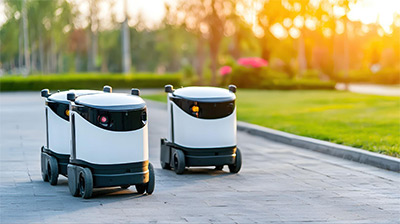
Autonomous delivery robots have reached a new level of maturity. No longer just experimental pilots or novelty applications, these systems are becoming a foundational layer of modern logistics infrastructure. Accelerated by adaptive autonomy, real-time orchestration, and scalable compute, delivery robots are changing how goods move through urban and semi-structured environments. For robotics professionals, this is a rapidly evolving domain for innovation in perception, motion planning, and system-level integration.
As delivery robots move beyond proof of concept, the focus has shifted from technical feasibility to system-wide optimization. Developers and integrators are now addressing the challenges of mature industrial automation, balancing throughput with safety, embedding modular intelligence at the edge, and aligning robotic behavior with enterprise objectives. What sets today’s systems apart is not only autonomy in motion, but autonomy in context: the ability to interpret complex, variable environments and make mission-critical decisions that support dynamic operations.
Delivery robots are proving themselves across a growing range of industries. In healthcare, autonomous systems are transporting lab samples and pharmaceuticals, improving traceability while reducing labor. In logistics, AMRs handle last-yard delivery within warehouses and distribution centers, linking upstream automation with last-mile fulfillment. Outdoor ground robots now operate in gated communities, business parks, and metropolitan areas, while aerial drones are beginning to close urgent delivery gaps in terrain-constrained or time-sensitive scenarios. These deployments mark a shift from viewing robots as standalone assets to seeing them as integrated nodes within broader logistical and data ecosystems.
From Concept to Capability: The Maturation of Delivery Robots
The delivery robot market, a part of the professional service robot category, is growing fast and is expected to reach $10B by 2035. This expansion is being driven not only by increased demand for contactless, efficient delivery services but also by architectural advances in robotics hardware and software.
Robots in this category are no longer limited to predefined paths or static environments. They can make contextual decisions and operate safely near pedestrians, cyclists, and vehicles. The growing adoption of the Robots-as-a-Service (RaaS) model is enabling organizations to deploy robotics infrastructure with minimal upfront capital. RaaS is working well for high-frequency use cases such as food delivery, warehouse replenishment, retail curbside fulfillment, pharmaceutical distribution, and parcel handling in logistics hubs.
Adaptive Autonomy in Dynamic Environments
At the heart of delivery robotics is continuous environmental perception and real-time response. These systems rely on a complex dance of multimodal sensor fusion, low-latency processing, and adaptive control algorithms to interpret and act on their environment with precision and autonomy. Operating in unstructured or semi-structured environments requires not just object detection but contextual awareness — the ability to understand intent, flow, and spatial relationships in dynamic human-centric spaces.
Companies like Realtime Robotics are pushing the boundaries of motion intelligence with technologies like RapidPlan, which generates optimized, collision free trajectories in milliseconds. Unlike pre-programmed pathing logic, RapidPlan allows on-the-fly recalibration to changing environmental constraints, supporting high-throughput multi-agent operations without compromising safety or predictability.
Complementing local autonomy, platforms like InOrbit’s RobOps deliver cloud native orchestration and observability at scale. In complex environments like medical campuses, robots governed by InOrbit integrate with physical infrastructure, follow operational rulesets, and adjust behavior based on real-time status inputs. Local AI modules make immediate decisions for obstacle avoidance and navigation while cloud based intelligence coordinates task distribution, load balancing, and multi-robot optimization across the fleet.
This layered autonomy architecture – local decision making with central orchestration – allows delivery robots to be resilient and adaptive across changing operational contexts. As robotic fleets scale and integrate more with enterprise systems, this architecture will be the foundation for fully autonomous logistics networks that operate with intelligence and intent.
Hardware and Edge Compute: Enabling Real-World Deployment
High performance onboard compute is non-negotiable for modern delivery robots; it’s the computational backbone for autonomy, perception, and control. Hardware like Cincoze’s GM-1000 is the kind of integrated system that can be deployed in the real world, with high-efficiency Intel Xeon or Core processors and modular MXM GPUs to accelerate AI inference, real-time SLAM, and dense sensor fusion. These units can handle concurrent workloads of 3D localization, multi-object tracking, semantic segmentation, and dynamic obstacle classification, all within power and thermal budget.
Equally important is the system’s mechanical robustness. Delivery robots operate in varied and unpredictable environments that include pavement transitions, inclines, curb cuts, and exposure to moisture or temperature fluctuations. Embedded compute modules need to meet industrial grade standards for shock, vibration, and ingress protection with wide temperature operating ranges and fanless thermal management to ensure long duration uptime in the field.
Edge computing mitigates the latency and bandwidth constraints of wide area networked deployments. Time critical operations like obstacle avoidance, trajectory re-planning and fail-safe behavior execution are handled locally with millisecond level responsiveness. In parallel, the cloud layer manages higher order functions like cross-fleet scheduling, telemetry aggregation, software updates, and long horizon optimization algorithms.
This distributed compute model, anchored by edge processing and orchestrated by cloud provides autonomy with observability. It’s a framework not only for resilient field operations but also for compliance with strict regulatory frameworks for patient privacy, data sovereignty and operational traceability in verticals like healthcare and urban public services.
Real-World Deployments: Robots in Action Across Urban and Sectoral Contexts
The growing adoption of delivery robots is not just a response to technological advancement, but a strategic response to mounting pressures in last-mile logistics. Widely recognized as the most inefficient and cost-intensive segment of the supply chain, last-mile delivery can account for up to 28% of total transportation costs. Rising e-commerce volumes, higher delivery frequency, fragmented shipment sizes, and congested curbside infrastructure have amplified the urgency to rethink how goods reach consumers. Compounded by labor shortages and post-pandemic consumer preferences for contactless fulfillment, autonomous delivery technologies are quickly becoming essential components in resilient urban logistics networks.

Get the Training You Need for a Safer Workplace!
Autonomous mobile robots are one of the fastest-growing segments of the robotics industry. During this live virtual training, you’ll be introduced to safety protocols and best practices for working with mobile robots in industrial settings.
Learn more and register now for upcoming training dates.
Several companies are already leading this transformation. Amazon, Walmart, Einride, Eliport, and UPS are actively piloting and deploying autonomous delivery systems ranging from sidewalk robots to aerial drones. Walmart alone has completed over 20,000 drone deliveries across its U.S. hubs and recently announced plans to expand coverage to 1.8 million additional households. These systems are used for rapid fulfillment of essential items such as meal solutions, household goods, and over-the-counter medications, with delivery times often under 30 minutes. By leveraging FAA-authorized Beyond Visual Line of Sight operations, Walmart’s drone providers Wing and Zipline are able to bypass traditional routing constraints and extend reach without relying on human observers.
Complementing aerial delivery, ground-based solutions are evolving to address geographic and infrastructural challenges. In Rome, researchers have modeled an advanced system where autonomous delivery robots utilize public transportation infrastructure to overcome battery limitations and reach urban zones otherwise considered unserviceable. By synchronizing robot routes with metro schedules and equipping trains with dedicated compartments for autonomous payloads, these hybrid systems have demonstrated cost reductions of up to 7.5% and significant emissions savings compared to both traditional and electric vans. Such integration of multi-modal routing represents a novel paradigm for sustainable urban logistics, especially in dense cities with established transit networks.
Meanwhile, companies like Coco Robotics are offering a different model for last-mile delivery by deploying remotely piloted sidewalk robots for food and grocery delivery in cities like Santa Monica. These compact units reduce reliance on cars for short trips, alleviate curbside congestion, and offer faster, cleaner service with contactless drop-offs. This is especially important for customers who still prioritize hygiene and minimal human contact following the pandemic. In densely populated environments where delivery vehicles exacerbate traffic and emissions, small and agile robotic platforms provide a compelling alternative that scales with urban complexity.
From drone corridors in Dallas to robot-equipped metro lines in Rome, the real-world deployment of delivery robots illustrates how logistics is being fundamentally reimagined. These systems are not merely automating tasks. They are reconfiguring the spatial, regulatory, and operational assumptions of last-mile distribution.
Engineering for Complexity: Design Considerations and Systemic Challenges
Transitioning from structured industrial settings to semi-structured and fully unstructured environments introduces a new tier of engineering complexity for delivery robots. Unlike fixed-path systems that are constrained by known surroundings, delivery robots must work in open, dynamic environments with variable geometry, transient obstacles, and human unpredictability. These environments require more computational agility and system-level resilience where perception, planning, and actuation must be tightly coordinated in real-time. To meet these demands, delivery robots must be engineered to meet a range of tough performance criteria:
- Computational efficiency: Real-time responsiveness must be maintained without sacrificing energy or thermal performance, which requires dynamic resource allocation to manage peak loads and keep the system up.
- Sensor integration: Reliable multimodal sensing with LiDAR, stereo vision, IMUs, and GNSS requires precise synchronization and calibration to enable real-time sensor fusion.
- Infrastructure interaction: Seamless integration with elevators, access points, and building systems through standard protocols requires secure real-time communication to support navigation in shared spaces.
- Safety and compliance: Public deployment requires rigorous safety validation, built-in redundancy, and adaptive behavior all aligned to ISO standards and tested in the real world.
Robust and scalable delivery robots require a delicate balance of autonomy, safety, interoperability, and cost-performance. This cannot be solved by software or hardware alone; it must be architected across the entire technology stack. Success depends on iterative refinement across perception pipelines, embedded control architectures, middleware orchestration layers, and safety assurance frameworks. For engineering teams, this means a cross-disciplinary design approach that combines robotics, embedded systems, AI, and regulatory foresight into field-ready solutions.
The Road Ahead for Robotic Delivery
Delivery robots are moving from a tactical point solution to a strategic enabler of cognitive logistics. As AI gets better at modeling environments, predicting behaviors, and optimizing under complex constraints, delivery platforms will become autonomous decision makers in the supply chain.
Fleet level coordination will go beyond static task assignment and include dynamic variables like energy availability, infrastructure status, traffic flow, and service level agreements. This level of contextual intelligence will allow systems to continuously reprioritize, adapt, and optimize in real time. The convergence of delivery robots with intelligent warehousing, smart urban infrastructure, and data rich edge networks will define the architecture of next gen autonomous logistics ecosystems.
To support this, system designs will focus on modularity, composability, and interoperability so we can adapt quickly across sectors and deployment contexts. Human-machine collaboration will be at the center of these designs, as a deliberate integration of human insight with machine precision in increasingly complex workflows.
For robotics professionals, this is one of the most technically challenging and commercially exciting frontiers in automation. Delivery robots are where autonomy, AI, embedded systems, and real world logistics constraints come together to create a dynamic environment for innovation.
 Are Robots Taking Jobs? Amazon Hits 1 Million!
 Robotics in Warehouse Automation: Trends to Watch
 Understanding robotic surgery
 How Medical Robots and Humanoids are Quietly Rewriting Care