
Everything You Need to Know About Robotic Welding
By leveraging the flexibility of robotic systems to automate routine welding tasks, manufacturers can improve product quality, increase throughput, and reduce the strain on skilled welders.
Table of Contents
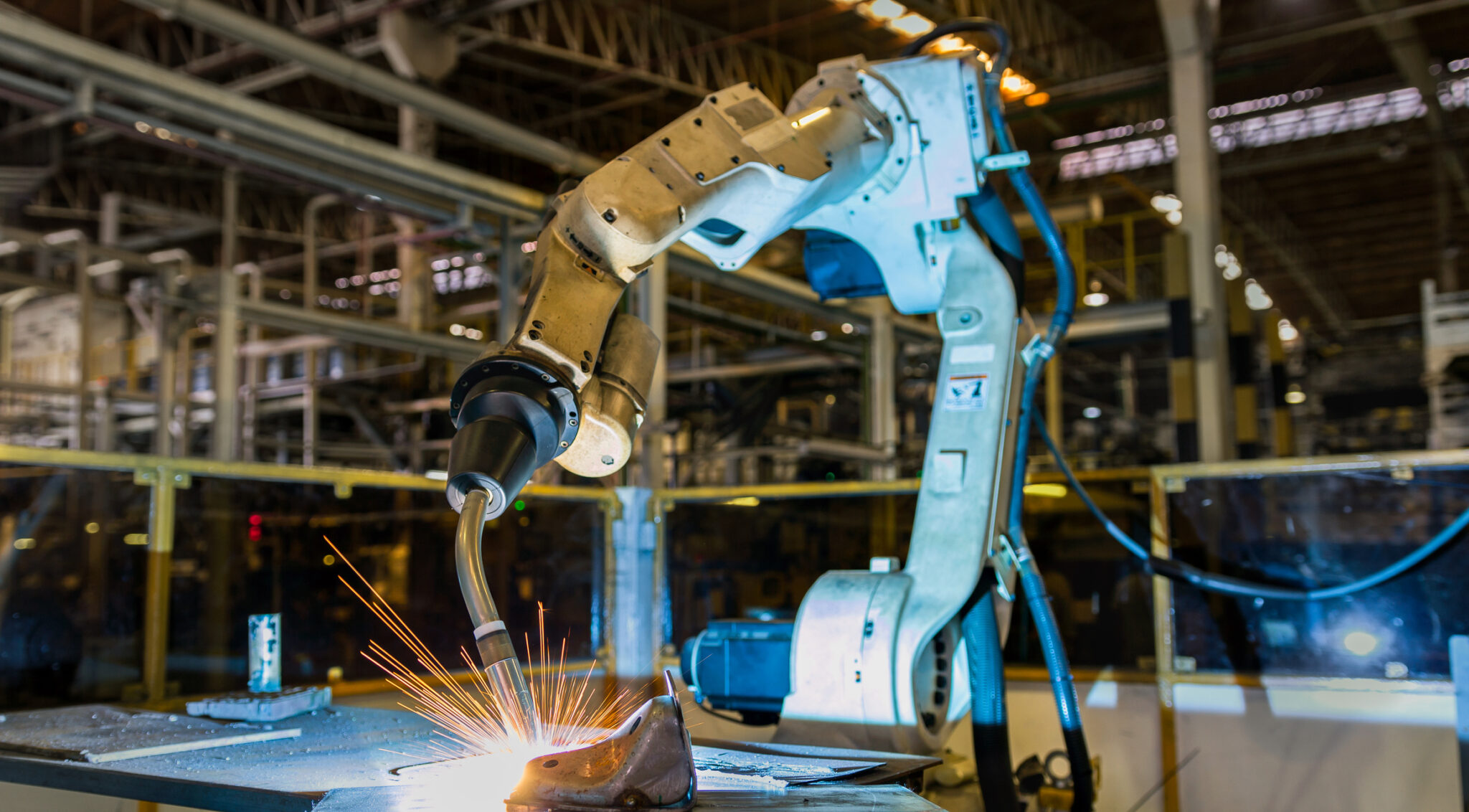
Robot welding is becoming a cornerstone of manufacturing automation. By leveraging the flexibility of robotic systems to automate routine welding tasks, manufacturers can improve product quality, increase throughput, and reduce the strain on skilled welders.
From assembling car frames to sealing aircraft fuselages, robot welding is reshaping how industries handle welding operations. This surge in adoption is fueled by a range of factors including the growing demand for precision welding and skills shortages.
With this rising interest in welding automation, there are staggering number of solutions and options for adding robotics to your welding process. The right solution can help you minimize human error, increase productivity, and enhance safety on the production floor.
In this guide, we provide a comprehensive introduction to robot welding, including the various types of welding, comparisons with manual welding, programming strategies, and more.
What is Robotic Welding? And What It Isn’t
Robot welding refers to the use of programmable robotic systems to automate welding tasks. By combining welding tools, robots, and programming software, such systems can offer an unmatched consistency in precision and speed over manual welding.
A typical robotic welding system comprises three principal components:
- Industrial robotic arm — This flexible, programmable mechanism moves along repeatable welding trajectories. In basic terms, it is comparable to the human in manual welding.
- Welding tool — The “business end” of the setup, the welding tool attaches to the end of the robotic arm. The type of tool depends on the type of robotic welding process.
- Programming software and control system — The programming software and robot control system are vital as they turn your 3D product models created in a CAD software into welding trajectories for the robot to follow.
These components combine to form a system for repeatable welding tasks in a range of applications. Usually, these involve repeatable, routine welding operations with consistent parameters.
However, it’s important to point out that robot welding is not a complete replacement for all manual welding. Human welders are highly skilled, adaptable, and flexible with problem-solving capabilities that even the most advanced artificial intelligence can’t match. For this reason, robot welding is best seen as a valuable tool to supplement skilled welding professionals.
9 Types of Robotic Welding (And How to Choose)
Understanding the different types of robot welding can help you select the right solution for your specific needs. If you are migrating from manual welding, you will probably pick a robotic solution that matches your existing manual welding process.
Here are 9 of the most common types of robotic welding, along with their respective strengths:
- MIG Welding — Metal inert gas (MIG) welding uses a robotic tool that continuously feeds consumable wire and emits a shielding gas. It is ideal for high-volume production and is known for speed and efficiency.
- TIG Welding — Tungsten inert gas (TIG) welding uses a non-consumable tungsten electrode along with shielding gas. It is ideal for producing clean welds with a good aesthetic finish.
- Laser Welding — Employing a high-energy beam of laser light, this method involves melting the material to fuse it together. It is often used in electronic and medical device manufacturing.
- Plasma Welding — This type of welding uses a robotic tool with a tungsten electrode, which forms an electric arc with the material. It is often used to weld stainless steel, aluminium, and other challenging metals.
- Resistance Spot Welding — This spot welding process involves passing a strong electric current through metal, which melts them together. It is used where only spots of weld are necessary.
- Thin Gauge Arc Welding — This arc welding process is used for welding together thin sheets of metal, such as in the welding of automotive panels. It is a delicate process that requires precision.
- Hybrid Welding — This method combines laser light and arc welding to offer a deeper penetration than laser welding alone. As a robotic application, it is especially useful for applications that require accuracy at high speed.
See our in-depth guide to robotic welding types 9 Types of Robot Welding: A Breakdown of Common Types.
How Robotic Welding Is Changing the Job of Welding
A common concern among both companies and employees is that robots will replace welding professionals. Some people are concerned that the job of welding will soon be a thing of the path, with only robots performing this complex and skilled task.
However, the rise of robotic automation doesn’t signal the end of skilled welding. Rather, robots are creating new opportunities for welders that understand automation and can program the new technology.
As is often the case with automation, robots are simply transforming the job of skilled welders.
A common change is that robotic technology is used to automate the most repetitive and routine types of welding task. This frees up skilled welders to focus on more complex and intellectually challenging tasks, such as welding custom parts and problem solving.
This shift involves adding additional responsibilities to the jobs of welding professionals. For example, welders now need skills to program robotic systems, design new welding cells, and troubleshoot problems.
Robotic Welding vs Manual Welding: 7 Categories to Compare
How can you decide about whether to use robotic or manual welding for a particular task?
When assessing a particular job for suitability for robot welding, it’s helpful to compare the two with the following useful categories:
1. Speed
For repetitive jobs, robots can maintain a constant speed in the way that human cannot. This makes robot welding faster than manual welding, but mostly because of this consistency. However, faced with unexpected changes, humans excel at adapting quickly.
Ask yourself: What is more critical for your operation, consistent output, or the ability to adapt on the fly?
2. Precision
Robots excel at providing consistent precision. The accuracy and repeatability of the robot arm plays a key role. For manual welding, the expertise of the individual person can greatly influence weld quality.
Ask yourself: Do your projects require precise, consistent welding? Or do they require a more artisan approach to weld quality?
3. Cost
The cost impact of robot welding isn’t just about the upfront investment. More important is the return on investment (ROI). Robots can lower long-term labor expenses, especially when there is a lack of skilled welders in the job market.
Ask yourself: Have you calculated the ROI of a robot? If not, check out these handy ROI calculators.
4. Safety
Welding can be a dangerous job with inherent risk from burns, fumes, and strain injuries. Robots remove workers from these hazardous environments, offering a safer alternative.
Ask yourself: Are some welding tasks in your process more dangerous than others, and how could you reduce this risk with a robot?
5. Scalability
Robots provide a way to scale resources that is much harder with the current human workforce. As newer generations have moved away from jobs like welding, the ability to scale operation with robots in an agile way is increasingly the only option in some cases.
Ask yourself: Is your business preparing for growth, and would robotic welding help you scale efficiently?
6. Training Requirements
It’s true that most companies that employ robots for welding need to invest in some training. However, this can benefit both your business and employees. There are also some effective strategies to reduce training time for robot welding including using the right software and leaning into dedicated programming wizards.
Ask yourself: What value would you get from adding more robot skills to your team?
7. Flexibility
Human welders remain unmatched in flexibility, with the ability to adapt to unique, custom, or artistic welding projects. However, a skilled professional welder who also knows robotic programming becomes an irreplaceable asset to your business.
Ask yourself: Are your projects heavily custom, requiring manual skills, or are some tasks routine enough to benefit from automation?
The Welding Skills Shortage (How Robots Help)
We can’t talk about robotic welding without discussing the global skills shortage of welders
The shortage of skilled welders is a pressing issue that affects businesses in a range of industries, including construction, manufacturing, and automotive. The reasons for this shortage are both complex and hard to solve.
One commonly reported cause of this shortage is the low number of younger people choosing jobs like welding. As many skilled welders age out of the workforce, a growing gap has opened up which companies are struggling to fill. Despite attempts to encourage younger people into welding jobs, training takes time.

Robots can help solve the welding skills gap in two ways:
First, adding robot welding reduces the need for skilled welders to engage in routine, repetitive welding tasks. This allows the welders to focus on more intellectually stimulating welding tasks.
Second, adding robot programming to a welder’s job description could make welding a more appealing job to new entrants to the workforce. It helps to move away from the common perception of welding as a “dirty job” into a job that is seen as high tech and specialized.
Even as new welding professionals enter the workforce, it looks certain that robots will be a key tool in the profession.
 What is the role of cameras in pick and place robots?
 What Can You Do With a SCARA Robot?
 Pick and Place Robots Decoded: Benefits, Applications, and Trends
 Before you invest in a palletizing robot