
Designing and Building a Walking/Bipedal Robot
Key steps for building a walking bipedal robot include: design for 10–12 degrees of freedom, with 5–6 joints in each leg. Build the frame from light materials like aluminum.
Table of Contents
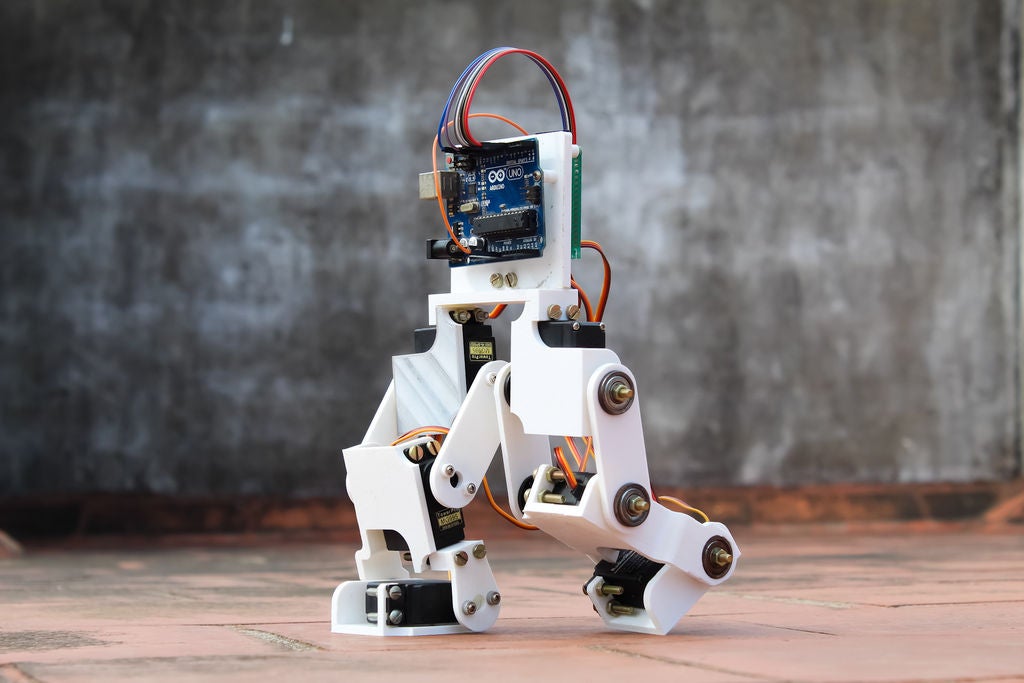
Key steps for building a walking bipedal robot include: design for 10–12 degrees of freedom, with 5–6 joints in each leg. Build the frame from light materials like aluminum. Choose high-torque servos for movement. Apply Zero Moment Point (ZMP) for balance. Control joint angles with inverse kinematics and incorporate sensors such as IMUs for feedback.
Key Points:
- Although they are less effective than wheeled designs, bipedal robots perform well in unstructured settings like stairs.
- At least 10 DoF enables effective walking, with ankle pitch and roll crucial for balance.
- ZMP robotics ensures stability by keeping the ground reaction point within the support polygon.
- For smooth motion, inverse kinematics transforms desired foot positions into joint angles.
- Raspberry Pi or Arduino can be used in low-cost builds, but power management is still difficult because of the high energy requirements.
Challenges and Considerations
Creating a bipedal robot is thrilling but requires balancing ambition with practicality. Dynamic gaits offer agility, while static walking is better for those just starting. Actuator costs can rise quickly, so begin with budget-friendly servos. Never overlook safety during your tests.
Designing a bipedal robot is thrilling, but it means juggling complexity and what’s actually possible.
Dynamic gaits give you agility, yet static gaits are better for beginners. Take Boston Dynamics’ Atlas; it shows off dynamic walking over tough ground. In contrast, Honda’s ASIMO blazed a trail with static stability for easier indoor movement.
Start with affordable servos to keep things under control because actuators can cause costs to spike. During testing phases, safety must be the top concern.
Why Walk When You Can Roll?
In robotics, wheeled models are the norm; they’re simple and sip energy on flat ground. Yet, when a robot must handle truly messy places—like going up stairs, crossing rocks, or maneuvering a jumble—walking designs, often bipedal, are absolutely necessary.
These machines copy how humans walk, which lets them step over things or climb where wheels would just get stuck. Even though they require significantly more energy, the difficulty of building a stable, walking robot has pushed innovators to create genuinely amazing devices.
Think about Boston Dynamics’ Atlas. This robot can do acrobatic flips and move through disaster areas using amazing balance. Then there was Honda’s ASIMO, an early key project that showed off fluid walking and how to handle objects in normal places.
These machines prove what walking robots might achieve. However, they also clearly show the difficult engineering problems: keeping them stable, making their power use efficient, and coding them to walk in a natural way.
Structure and Movement (DoF)
The base of two-legged robot is its mechanical structure. This part looks at the main pieces. It makes sure your design can move both stably and without wasting energy.
The Critical Role of Degrees of Freedom
The number of distinct movements a robot’s joints can perform is known as its degrees of freedom, or DoF.
A two-legged robot requires at least 10 to 12 DoF to walk like a human. It means that five or six joints are used by each leg. This setup lets the robot move its hip, knee, and ankle, which copies the movement of human legs.
The ankle joint is extra important. When the ground is not level, two degrees of freedom (DoF) are required to keep everything balanced: pitch (tilting front-to-back) and roll.
The robot will struggle with side-to-side stability and fall if these are gone. A simple robot might have yaw, roll, and pitch at the hip, pitch at the knee, and pitch and roll at the ankle for each leg. Complex robots, like full humanoid avatars, might have over 30 DoF for full-body action. Still, starting with 10-12 DoF makes the design much easier for new builders.
Here’s a breakdown of typical DoF distribution:
| Joint Location | Degrees of Freedom | Purpose |
| Hip | 3 (yaw, roll, pitch) | Leg rotation and swing |
| Knee | 1 (pitch) | Bending for step height |
| Ankle | 2 (pitch, roll) | Balance and terrain adaptation |
| Total per Leg | 6 | Enables full gait cycle |
Material Selection and Weight Distribution
Choose lightweight materials to give your project a responsive feel. Aluminium and carbon fibre are excellent choices. They reduce overall weight, allowing limbs to move more easily and using less energy.
Aluminum is a popular hobby material due of its low cost and ease of shaping. Carbon fiber is different. It’s incredibly strong without the weight, perfect for high-end designs where performance is key. Think of it like sports gear—light but tough.
The Center of Mass (CoM) should be low and in the center of the robot’s body because weight placement is crucial.
Doing this makes the control programs simpler because less twisting force (torque) is needed to keep balance. For instance, put the batteries and heavy parts down low near the waist. Keep the upper body light. If the weight is spread poorly, the robot can become unstable. The CoM will move in ways you can’t guess when it takes a step.
Actuator Selection: High-Torque Servos
Actuators are often the most expensive parts when building a walking robot.Cheap servos like the MG996R are a low-cost way to start. They give enough turning power (around 10-13kg-cm for smaller, two-legged robots.But if you need very precise control over the robot’s walk, professional options like Dynamixel servos are much better. They offer greater power (up to 40kg-cm) and have feedback systems built right in.
Compare them:
| Servo Type | Torque (kg-cm) | Precision | Cost Range |
| Hobby (MG996R) | 10-13 | Medium | $5-15 |
| Professional (Dynamixel) | 20-40 | High | $50-200 |
You need high twisting force (torque). This is key to fighting gravity and stopping the robot’s momentum during the swing of a leg. At the same time, precision keeps all the joint movements smooth.
For a low-cost bipedal mechanism, start with hobby servos and upgrade as needed.
The Core Challenge – Stability Control
Stability is the make-or-break factor in bipedal locomotion. This section, focusing on ZMP robotics, provides in-depth insights into achieving reliable walking.
Understanding the Zero Moment Point (ZMP) Principle
ZMP is a cornerstone of bipedal stability, defined as the point on the ground where the net moment of inertial and gravitational forces has no horizontal component. For stable gait, the ZMP must remain within the support polygon—the area under the feet in contact with the ground.
If the ZMP shifts outside, the robot tips over. In practice, calculate ZMP using forces and moments:
where m is mass, g gravity, and accelerations are considered. This principle underpins modern ZMP robotics, enabling dynamic balance.
Static vs. Dynamic Walking Gaits
Static walking keeps the CoM always within the support foot, ideal for slow, heavy-load scenarios like early ASIMO models. It’s simpler to control but energy-inefficient.
Dynamic walking, as in Atlas, allows the CoM to venture outside the support area, relying on inertia and quick corrections to “catch” falls. This enables faster, more natural gaits but demands advanced feedback.
| Gait Type | Speed | Stability Method | Example |
| Static | Slow | CoM always inside support | ASIMO early versions |
| Dynamic | Fast | Inertia and control | Atlas |
Transitioning from static to dynamic requires robust sensors.
Sensory Feedback: The Role of IMU and Encoders
An Inertial Measurement Unit (IMU) is used to figure out the robot’s tilt, speed, and how fast it’s spinning to help the robot constantly make small changes to stay balanced. Joint encoders track angles precisely, feeding into control loops.
Integrate a 6-axis IMU for pitch/roll detection and optical encoders for sub-degree accuracy. In bipedal robots, these sensors fuse data via Kalman filters for reliable state estimation.
Programming and Kinematics
With hardware in place, programming brings the robot to life. This inverse kinematics tutorial guides you through motion control.
Demystifying Inverse Kinematics (IK)
Inverse kinematics solves for the joint angles (θ1,θ2, etc.). It does this when you already know where the end-part should be (like putting the robot’s foot at (x, y, z)).IK is different from forward kinematics. It uses large math tables (matrices) or a method that repeats steps (iterative methods) like using the Jacobian inversion.
For a simple leg:

often solved numerically. Libraries like ROS or Python’s ikpy simplify this.
Gait Generation and Trajectory Planning
A gait cycle includes swing (leg in air) and support (leg on ground) phases. Use Bézier curves for smooth trajectories: a cubic Bézier is
ensuring jerk-free motion. Plan cycles to alternate legs, adjusting for speed.
Control Loop Implementation (PID Controllers)
PID controllers keep the robot’s joints precise.
- Proportional (P): Fixes the current error.
- Integral (I): Gets rid of slow drift (steady-state offset).
- Derivative (D): Stops the joint from overshooting the target (dampens).
You need to tune the settings (gains) for every joint. For example, use a higher P value for a faster response.
Practical Build Guide and Optimization
Selecting the Brain: Microcontroller vs. SBC
Microcontrollers like STM32 handle real-time tasks efficiently, while SBCs like Raspberry Pi excel in high-level planning.
| Type | Strengths | Use Case |
| Microcontroller (STM32) | Low power, real-time | Joint control |
| SBC (Raspberry Pi) | Processing power | Vision, planning |
Combine them for hybrid control.
Power Management and Battery Life
Walking robots consume high power due to constant actuation. Use LiPo batteries (11.1V, 2200mAh) and monitor voltage drops, which affect servo performance. Optimize with efficient gaits and sleep modes.
Troubleshooting First Steps (Tips for Beginners)
Begin with single-leg tests on a rig to avoid damage. Debug code in simulation first. Common issues: servo overload—check torque ratings; imbalance—adjust CoM.
The Future of Bipedal Locomotion
In the future, autonomous gait optimization is promised by reinforcement learning (RL). RL agents learn balance on varied terrains by trial-and-error, achieving natural movements beyond traditional methods. Frameworks like OpenAI Gym enable this, paving the way for adaptable robots in real-world applications.
 2026 Smart Robotics Industry Report
 Servo Motors Explained and Why They’re Useful in Robotics
 The Importance of Harmonic Drive Technologies in Modern Robotics
 LiDAR Sensor for Robotics: Complete Guide to Navigation and Mapping